How to Find High-Quality Suppliers of Luggage and Bag Fittings
Luggage hardware serves as the core functional and aesthetic element of finished leather goods. The material, plating precision and durability of accessories such as fastenings, locks, chains, metal nameplates and pull-tabs directly determine the quality of the luggage, the after-sales return rate and the brand’s reputation. Many leather goods manufacturers, original luggage brands and cross-border e-commerce sellers focus solely on unit prices when sourcing, overlooking suppliers’ production qualifications, end-to-end quality control, customisation capabilities and delivery reliability. This ultimately leads to losses resulting from issues such as widespread colour fading, broken fasteners, dimensional deviations and delivery delays.
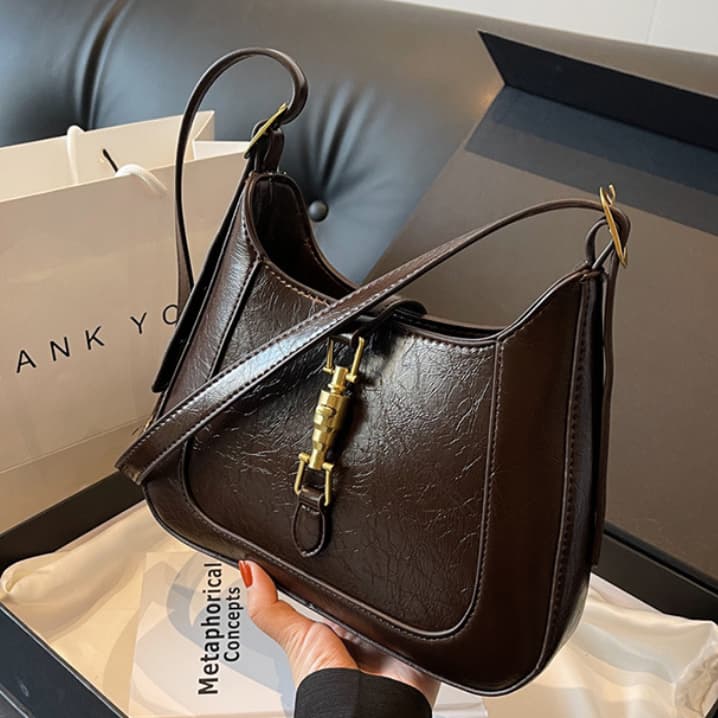
Finding high-quality luggage hardware suppliers cannot rely on sporadic online enquiries; it requires establishing a comprehensive system for sourcing, screening, verification, collaboration and long-term maintenance. Drawing on practical industry experience, this article provides a detailed breakdown of the entire process. Using OYC Accessories—which has specialised in the high-end luggage hardware sector for 15 years—as a benchmark case study, it clearly illustrates the criteria for evaluating top-tier, qualified suppliers.
Precise sourcing through multiple channels, selecting source factories rather than intermediaries
The first step in procurement is to prioritise broadening sourcing channels, distinguishing between three types of entities: pure traders, small-scale wholesale stall operators, and source factories with in-house full-process production capabilities. Source factories are the optimal choice for long-term, stable procurement. A large number of intermediaries in the market do not have their own die-casting or electroplating workshops; they subcontract orders through multiple layers, making it impossible to control quality, lead times or after-sales service. Novice buyers are highly likely to fall into these pitfalls.
Offline trade fairs and on-site visits to industrial clusters
China’s two core industrial clusters for luggage hardware are concentrated in Huadu, Guangzhou, and Nanhai, Foshan, in Guangdong, as well as in Yiwu and Yongjia, Zhejiang, where a large number of hardware processing factories with comprehensive supporting facilities are clustered. Every spring and autumn, leather goods and luggage accessories trade fairs bring together reputable factories from across the country; visitors can handle physical samples, inspect mould libraries and liaise directly with technical managers on site, making communication far more efficient than online text-based exchanges.
When visiting industrial clusters in person, prioritise manufacturers with factory premises exceeding 5,000 square metres that possess independent die-casting workshops, automated electroplating lines and specialised quality control laboratories, whilst avoiding traders who operate only from market stalls without production facilities. At the exhibition, you can collect sample catalogues from over 30 factories simultaneously, noting each company’s main product categories, minimum order quantities and customisation lead times for subsequent tiered screening.
Precise screening on B2B online platforms to distinguish between manufacturers and traders
Platforms such as 1688 and Made-in-China serve as basic sourcing channels; however, over half of the sellers on these platforms are intermediaries. To identify genuine manufacturers, buyers should consider the following three criteria: Firstly, the shop should have uploaded complete videos of the factory premises, die-casting equipment, electroplating production lines and quality inspection laboratories; secondly, the business licence must specify ‘manufacture of metal products’ and ‘die-casting processing’ within its scope of business, and the company must have been registered for at least five years; thirdly, they must offer real-time video factory tours, rapid mould production based on provided drawings, and be able to supply material testing reports.
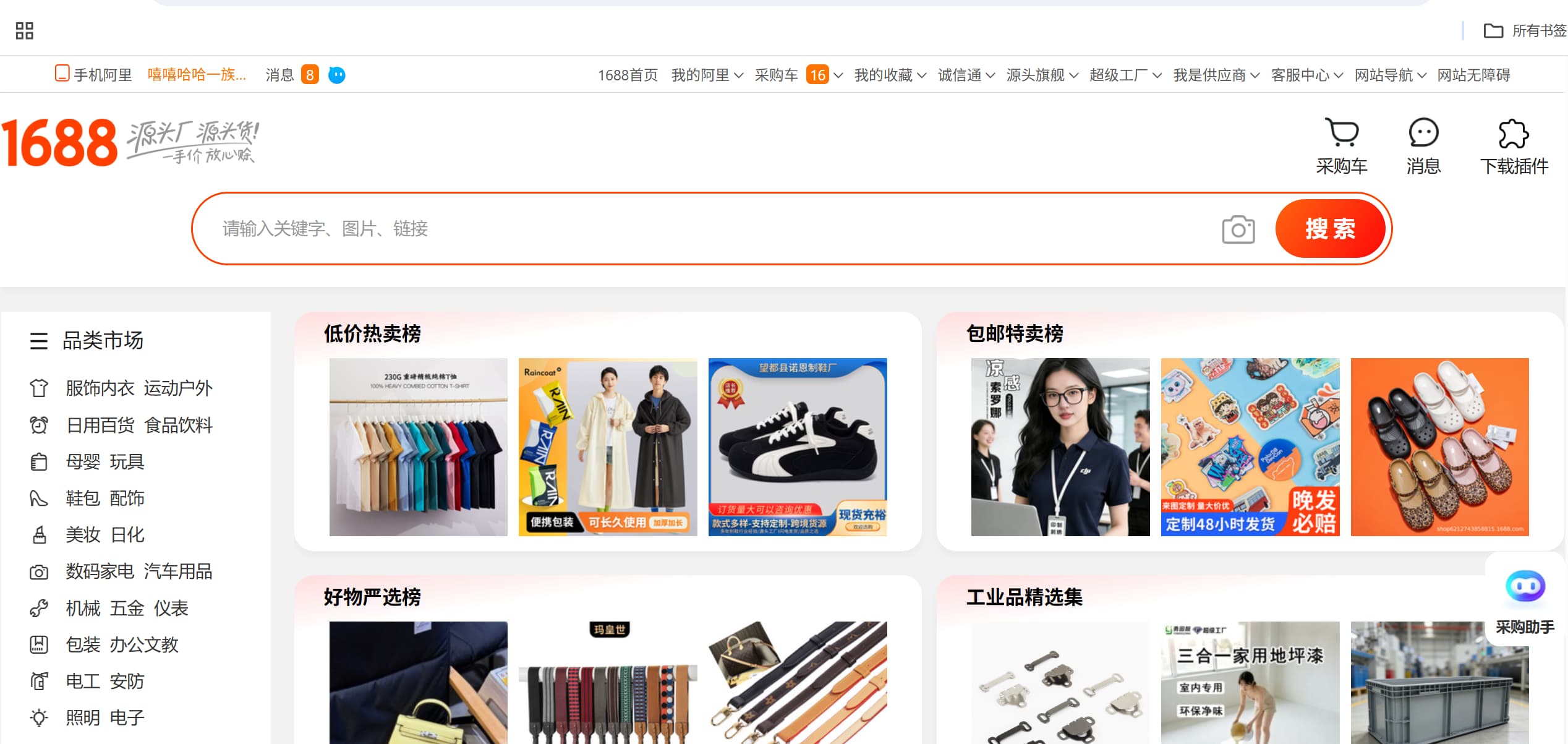
When screening, actively exclude suppliers who only offer stock items, cannot customise logos, or refuse to provide actual workshop footage; such suppliers are often second-hand wholesalers and are unable to meet a brand’s differentiated customisation requirements.
Recommendations from peers and upstream/downstream supply chain partners
Word-of-mouth recommendations from reliable suppliers within the industry are the most effective. Leather tanneries, luggage manufacturers and fellow brand buyers with whom you have long-standing partnerships will proactively share details of reliable hardware manufacturers; high-quality hardware manufacturers will also recommend peers specialising in complementary product categories to each other, thereby avoiding direct competition.
Ask your existing suppliers for a list of the industry’s leading players; manufacturers who are willing to provide honest information about competitors’ strengths without deliberately disparaging their peers typically adhere to production standards and operate with integrity.
Trace Competitors’ Origins to Identify High-Quality Supply Chains
Dissect high-end luggage and leather goods that are bestsellers online and overseas, examine the product’s metal nameplates and the information on the accessories included in the packaging, record the names of the hardware manufacturers, verify the factories’ qualifications via corporate credit platforms, and source directly from the original manufacturers. Hardware suppliers chosen by high-end brands generally have comprehensive quality control systems in place and comply with overseas export quality inspection standards.
Establishing a Standardised System for Assessing Suppliers’ Core Capabilities
Once an initial list of suppliers has been compiled, a quantitative assessment framework is established to score and eliminate unsuitable suppliers based on four key criteria: qualifications, production line equipment, raw material control and production capacity. This step directly filters out small-scale workshops and outsourced intermediaries.
Verifying a company’s compliance credentials to mitigate operational risks
First, verify basic information via Qichacha and the National Enterprise Credit Information Publicity System: the duration of the business licence, registered capital, any operational irregularities, disputes over sales contracts, and records of environmental penalties. The electroplating process for luggage hardware requires a pollution discharge permit; small factories without proper environmental credentials face the risk of production shutdown at any time, which can easily lead to a disruption in order fulfilment.
For export-oriented brands, suppliers are required to provide REACH, RoHS and nickel release test certifications. The European and American markets have mandatory standards regarding heavy metal content in metal fittings; factories without compliance reports are unable to accept overseas orders.
Benchmark Case Study: OYC Accessories, established in 2017, has specialised in the customised production of luggage hardware for 10 years. The company holds comprehensive environmental discharge and metal processing production licences, as well as full SGS and CASS salt spray testing laboratory certifications. It has served over 100 domestic and international leather goods brands to date, and can provide a full set of compliance test reports for all export orders, thereby mitigating the risk of goods being detained by overseas customs at source.
Verification of fully in-house production lines to eliminate outsourcing
High-quality suppliers must have in-house capabilities across the entire production process, including die-casting, CNC machining, polishing, electroplating and assembly. Factories that outsource the entire production process are unable to uniformly control the parameters for each stage, making them prone to issues such as colour variations between batches, porosity and dimensional errors.
On-site or video factory audits should focus on the following equipment: fully automatic zinc alloy die-casting machines, precision mould engraving machines, automated electroplating production lines, tensile testing machines, wear resistance testers and salt spray test chambers. Workshops that rely solely on manual polishing and lack specialised testing equipment produce goods of extremely poor consistency.
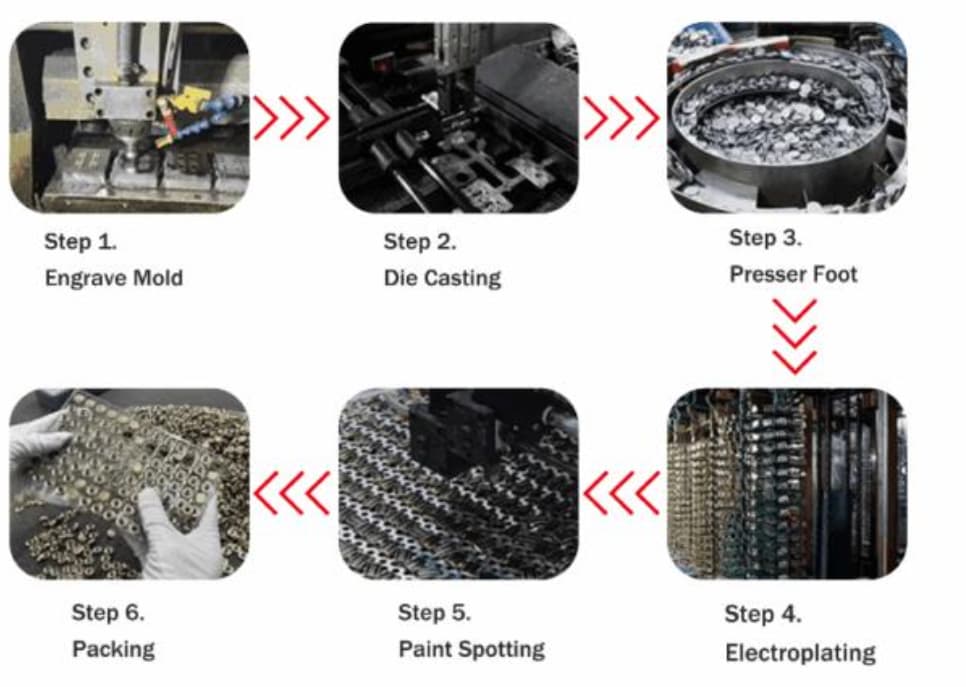 | 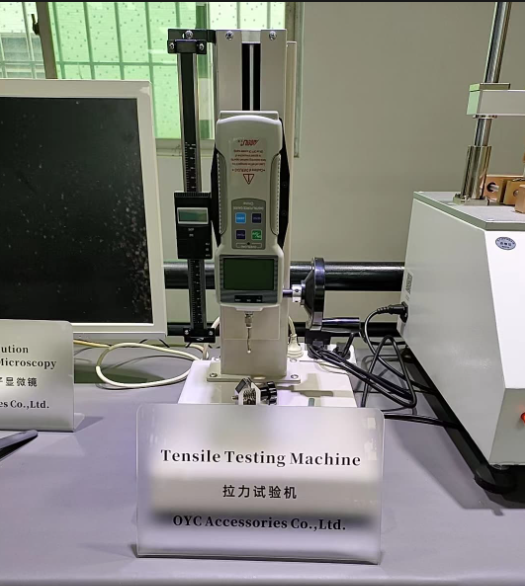 | 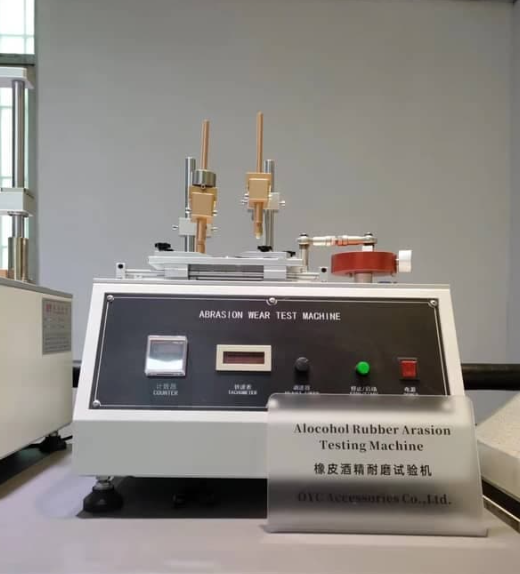 |
OYC Accessories has established an integrated smart production workshop, carrying out the entire process in-house—from mould engraving, die-casting, hand-finishing and multi-layer electroplating to final assembly—without outsourcing any core processes; The workshop is equipped with a standardised laboratory, which is permanently stocked with a CASS copper-accelerated salt spray tester, a tensile life tester and a high-resolution metallographic microscope. A full suite of performance tests is carried out on every batch of metal components prior to dispatch, ensuring consistent quality right from the production stage.
Strict grading and control of raw materials; we refuse to accept substandard recycled metals.
Small, low-cost workshops purchase large quantities of recycled zinc alloy scrap and substandard thin sheet metal. The resulting hardware components are lightweight and riddled with internal pores, making them highly prone to fracture under stress; they also exhibit poor electroplating adhesion and will rust and discolour after only a short period of use. Reputable manufacturers consistently source Grade 1 zinc alloy, 304 stainless steel and pure copper in accordance with national standards. They retain purchase documentation for every batch of raw materials and can provide material composition test reports.
When inspecting samples during procurement, a simple weight comparison can be carried out; high-quality hardware of the same specification will weigh significantly more than inferior products made from recycled materials. At the same time, suppliers must clearly distinguish between quotations for standard materials and high-end, thickened materials, and must not mix materials to reduce costs. OYC Accessories is committed to using brand-new zinc alloy raw materials that comply with national standards and refuses to use recycled scrap in production. Compared to standard industry models, our D-rings and lobster clasps of the same specification are 0.2 mm thicker. They have passed a durability test involving 5,000 opening and closing cycles without loosening or deformation, making them suitable for long-term use in high-end ladies’ handbags and outdoor rucksacks.
Assessment of production capacity and delivery flexibility to match order size
The company evaluates supplier capacity against our order volume: small workshops achieve less than 50,000 units per day and suit orders of just a few hundred; medium-sized factories generate 100,000–300,000 units daily and fit the batch requirements of domestic mid-sized brands; large automated plants deliver over 500,000 units per day and support urgent peak-time orders from major cross-border sellers and offline chain stores..
Simultaneously verify the number of moulds in stock, the moulding lead time and the delivery time for standard products. High-quality manufacturers typically maintain a stock of over 6,000 mature, universal moulds, eliminating the need for repeated moulding and significantly reducing new product development costs. OYC Accessories maintains a stock of over 6,000 universal hardware moulds and over 20,000 original design drawings. Our production team ships standard stock orders within 7 days, completes design proposals for custom moulding in as little as 8 hours, and maintains bulk-order production cycles under 18 days, with delivery efficiency 50% above the industry norm. We also set up a dedicated scheduling channel during peak periods so that no order faces endless waiting
In-depth Product Quality Verification: Sample Testing and Quality Control System Assessment
Our quality assurance team proceeds to the core verification phase after hardware specifications are satisfied. We never rely on visual inspection alone for quality assessment; rather, we conduct multi-dimensional physical sample testing and concurrently examine the supplier’s internal QC systems to differentiate between ‘post-production random sampling’ and ‘full-process quality management
Multi-dimensional sample testing to quantify quality standards for hardware fittings
Request three complete sets of the same product from each shortlisted supplier; conduct four basic tests simultaneously and retain the test records as the basis for subsequent acceptance
Salt spray corrosion resistance test: High-end luggage hardware must pass a 48-hour neutral salt spray test without showing any rust spots or coating flaking; low-cost products typically show signs of blackening and oxidation after just 24 hours, making them unsuitable for accessories such as rucksacks and shoulder straps that are in prolonged contact with sweat.
Opening and Closing Durability Tensile Test: Lobster clasps, snap fasteners and locks must withstand 5,000 repeated opening and closing cycles without jamming, breaking or loosening; inferior products experience spring failure as early as 2,000 cycles.
Dimensional tolerance inspection: In automated die-casting, tolerances for high-quality products are controlled within ±0.05 mm, meaning that webbing and leather components require no secondary trimming; in hand-crafted workshops, tolerances exceed ±0.2 mm, increasing the cost of rework during factory sewing.
Texture and visual detail inspection: Edges and corners are free from burrs that could cause scratches; electroplating is uniform with no colour variation; the logo engraving is clear with no smudged edges; the plating has strong adhesion; and adhesive tape does not peel off in large sections even after repeated application.
OYC Accessories implements an in-house sample testing process that exceeds industry standards. All customised hardware undergoes 100% triple testing—including salt spray, tensile strength and abrasion resistance—prior to dispatch. Test reports for each batch are retained in the laboratory, and the test data is provided to the customer upon delivery. This eliminates the need for customers to commission additional third-party testing, thereby significantly reducing the testing costs associated with new product development.
Verification of the supplier’s end-to-end quality control management system
Ordinary factories typically conduct only simple spot checks on finished goods prior to dispatch, resulting in a high probability of defective batches; high-quality factories, however, implement a three-tier quality control process comprising ‘pre-production raw material inspection, in-process inspection, and 100 per cent inspection of finished goods’. Our factory assigns dedicated quality control personnel to each production stage and records production parameters in real time at key workstations such as electroplating and die-casting
On-site factory audits focus on inspecting quality control logs, areas for the segregation of substandard products, and the rework procedures for defective items. Compliant factories categorise and store defective products—including those with sand holes, colour discrepancies, and dimensional non-conformities—and they ensure that these items are uniformly reworked or destroyed, so that they never mix them with compliant batches for dispatch
OYC has established a standardised quality control manual. Throughout the production process, inspections cover key parameters such as die-casting temperature, electroplating thickness and polishing roughness. All finished products are manually inspected one by one for appearance and functionality, whilst defective items are processed centrally in a designated isolation area. Over the past three years, the batch defect feedback rate from our partner clients has been below 0.3 per cent, significantly lower than the industry average defect rate of 3 per cent. As a result, our long-term partner brands do not need to frequently deal with after-sales returns or exchanges of hardware products.
Comprehensive Assessment of Service Capabilities: Customisation, Prototyping, After-sales Support and Transparency of Quotations
Assuming equivalent quality, a supplier’s service system determines the smoothness of long-term collaboration. Whilst many factories meet the necessary hardware standards, their long prototyping lead times, high minimum order quantity thresholds and a tendency to shirk after-sales responsibilities make them unsuitable for small and medium-sized brands and the rapid product iteration requirements of fast fashion.
Efficiency in Custom Development and Prototyping
In today’s luggage industry, new products are released at a rapid pace. Suppliers need to be able to swiftly undertake custom orders based on provided drawings or samples, and support personalised adjustments such as embossed logos, laser engraving and special electroplated finishes (including matt gunmetal, antique bronze, bright gold and brushed nickel).
Focus your enquiries on three key service areas: the timeframe for free design proposals, the lead time for the first prototype, and whether additional charges apply for design revisions. High-quality manufacturers have dedicated design teams that can provide an accurate quotation within 30 minutes and a customised technical solution within one hour; for small-batch design revisions, only a nominal mould cost is charged.
OYC Accessories has established a dedicated R&D and design team for new products. We provide detailed quotations within 30 minutes and deliver renderings of original hardware designs within 8 hours, while supporting flexible small-batch customisation with low MOQs for start-up brands and artisan workshops, without forcing large-volume orders, and we tailor our services to the cross-border e-commerce model of multiple SKUs and rapid small-order response
Breakdown of quotation details to eliminate hidden charges
Be wary of suppliers who only quote a total price for individual items without providing a breakdown, as this can lead to hidden surcharges later on, such as moulding costs, rush plating fees or colour-change surcharges. A proper quotation must clearly specify: the unit price of each metal component, moulding costs, price differences for plating processes, packaging costs, logistics costs, taxes, and whether sample fees are refundable upon placing a bulk order.
When comparing quotations from multiple suppliers, do not focus solely on the low unit price; instead, calculate the comprehensive costs, including moulding, after-sales support and reorder costs. Low-cost manufacturers often cut costs by reducing plating thickness or using recycled materials; however, long-term after-sales wastage can actually increase overall procurement expenditure.
After-sales Support and Flexible Order Policies
Our trusted manufacturing partners maintain transparent after-sales terms: they exchange at no cost any items with plating defects such as fading, cracks, or size deviations within the warranty; they allocate rush-order priority during busy seasons; and they accept small-batch replenishment orders from inventory without imposing any MOQ
Prioritise manufacturers that offer 24-hour online customer service and a dedicated order coordinator to monitor orders throughout the process; in the event of quality issues, they can swiftly provide solutions and will not shirk responsibility for customer losses by claiming ‘no liability once goods leave the factory’. OYC provides round-the-clock online customer service and assigns a dedicated order coordinator to every order. In the event of quality issues arising within the warranty period, new products will be supplied free of charge. We offer lifetime technical support for hardware manufacturing processes, and can assist overseas clients with third-party inspections. Our comprehensive after-sales system minimises supply chain risks for brands.
On-site factory inspections and small-batch trial orders are required to finalise the selection process.
Our sourcing department uses online paperwork and lab samples only at the screening stage, while we require a full on-site factory review before we sign any formal long-term deal. We also arrange small-batch trial production to test on-time delivery and QC consistency, protecting ourselves against the significant risks of jumping straight into mass orders
Key Points for On-Site Factory Audits
Upon arrival at the factory premises, inspect the six main areas in sequence, whilst filming the entire process to maintain a video record:
- Raw materials storage area: Distinguish between new raw materials and recycled waste; check the raw materials quality inspection reports;
- Mould workshop: Number of in-house moulds in storage; operational status of engraving equipment;
- Production line: Operational status of automated die-casting, polishing and electroplating equipment;
- Quality control laboratory: Full set of testing equipment; recent batch test reports;
- Finished goods warehouse: Clear categorisation and zoned storage; presence of protective packaging for finished goods;
- Office and after-sales records: Past customer orders; after-sales handling records.
The company insists on real-time video facility tours from suppliers during any procurement where physical inspection is unavailable, and it turns down any supplier that provides only pre-existing images or objects to live filming of their workshops
Small-batch trial orders to comprehensively assess overall capabilities
We select 2–3 optimal candidate suppliers and place trial orders of 500–2,000 units with each, simultaneously assessing four key metrics: on-time delivery rate, product batch consistency, packaging integrity, and after-sales response speed. Our sourcing team disqualifies manufacturers straight away if they cause delivery holdups, batch colour mismatches, or poor service responsiveness in the trial stage, and we keep only suppliers with perfect performance across the whole trial as our permanent core partners.
Many buyers skip the trial order stage altogether, placing large initial orders of tens of thousands of items. Should batch quality issues arise, they not only incur the cost of the hardware components but also face delays in the dispatch of finished luggage products, thereby missing the sales window. OYC supports a tiered collaboration model for clients—first sample testing, then trial orders, followed by long-term cooperation—allowing clients to first obtain a small number of samples for testing. Only after successful trial production of small orders is an annual framework procurement agreement signed, thereby reducing the client’s trial-and-error costs.
Long-term Supplier Relationship Management and Risk Control
ur procurement team maintains active relationship management with selected high-quality suppliers beyond the first purchase, sets up a stable supply chain mechanism, and also keeps 1–2 backup high-quality manufacturers on hand to reduce the risk of relying on a single source
Sign a standardised procurement contract to ensure quality standards are met
Upon formal collaboration, sign a written procurement contract that clearly sets out all quality standards: material grades, electroplating salt spray test duration, dimensional tolerances, rules for the return or replacement of defective goods, and compensation clauses for late delivery. At the same time, seal a standard sample signed and confirmed by both parties to serve as the basis for acceptance of each batch of production goods. Verbal agreements offer no legal protection; in the event of a dispute, it will be impossible to assert one’s rights.
Conduct regular annual reviews to update the supplier portfolio
Each year, we carry out a comprehensive review of our key suppliers, scoring them across four key dimensions: quality, lead times, service and price, and removing manufacturers whose scores have consistently declined. At the same time, we continuously seek out new, high-quality suppliers, maintaining a pool of 2–3 alternative suppliers for each category of hardware, so that we can swiftly switch supply channels in the event of factory closures, price increases or insufficient production capacity.
Forge close partnerships with high-quality suppliers to gain a competitive edge in procurement
Brands with long-term, stable and high-volume procurement requirements can enter into annual framework agreements with leading suppliers to secure fixed unit prices for the entire year, priority production scheduling and priority support for new product development. Taking OYC Accessories as an example, long-term brand clients both domestically and internationally can enjoy value-added services such as exclusive mould discounts, priority production during peak seasons and free hardware design for new products, thereby significantly reducing the overall costs of new product development and bulk procurement.
Summary
Finding high-quality suppliers of luggage and bag hardware involves a standardised and practical procurement process, the core logic of which comprises four steps: multi-channel sourcing, quantitative verification of hard credentials, comprehensive quality testing of samples, and final validation through trial orders and on-site factory inspections. Procurement should not rely solely on low prices; instead, it must take into account a comprehensive assessment of the factory’s fully autonomous production lines, raw material control, specialised quality control laboratories, flexible customisation services and comprehensive after-sales support.
Leading high-quality hardware manufacturers in the industry, such as OYC Accessories, fully embody all the core characteristics of an excellent supplier—including compliance certifications, fully automated end-to-end production, standardised testing systems, rapid customisation and development, and round-the-clock after-sales support—making them the benchmark choice for long-term, stable procurement by luggage brands. A stable, high-quality hardware supply chain not only reduces the need for after-sales repairs on finished products and enhances the perceived value of luggage through superior quality, but also ensures the smooth iteration of new products and the maintenance of delivery schedules during peak seasons, thereby becoming one of the core competitive advantages for leather goods brands.

oyc
High Quality metal fitting, Dog Hook, Metal Ring,customer made Logo Plate